Parenting Expectations

Gender rules are taught from childhood. These expectations are not innate; they are made that way over time.
Gender norms are upheld by gender policing. Gender policing happens when others reward someone for acting one way or another based on their gender or reprimand someone for not acting how they “should” based on their gender (Wade & Ferree). When talking about parenthood, people might compliment a mother for caring for her children but question a father for doing the same behavior.
There have been studies that prove how these expectations are made based on social constructions of ability. Downey, Ainsworth-Darnell, & Dufur (1998) studied the differences in outcomes for children in lone-parent families. They found that children’s well-being had less to do with whether they were mothered or fathered and more to do with resources and the overall family environment. If parenthood were based on ability, children in single-mother households would fare worse because “women” are unable to provide as fathers can.
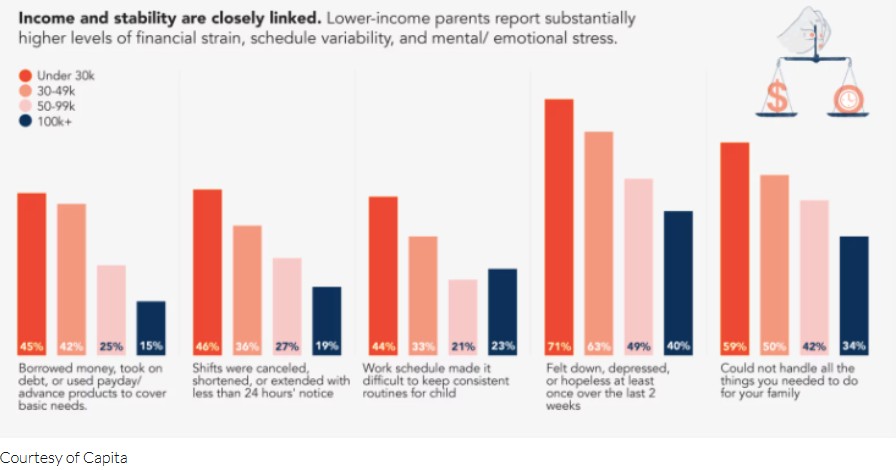
In research about family structure and access to care, it was found that differences in children’s upbringing had less to do with gender and more to do with access to certain resources (Leininger, 2008). Fathers could be less qualified than mothers, not because of their gender but because they don’t have access to the same systems of support. Our society does not expect fathers to care for children.
Another study done on gender socialization helped show how society begins to form expectations of gender at a young age (Raley & Bianchi, 2006). Children are taught the roles of how they should provide and care for others based on their gender. This sets the stage for parenthood to be seen as something that differs based on gender, when we know that caretaking ability does not.
Additional Research from Chapter 10, Gender: Ideas, interactions, institutions (3rd ed.)
- Families come in all shapes and sizes. There is no such thing as a “normal” family.
- Parenting is a social construct. There are no inherent expectations for mothers and fathers. They are created by our society.
- “Intensive mothering” is an ideology that expects women to invest a lot of time, energy, and emotion into caregiving.
- Men often receive praise for doing the bare minimum in caregiving that is expected of mothers.
- Women often do more childcare and housework than their partners, even when they are working full-time jobs. This is called the “second shift.”
- Fatherhood has evolved over the years. Fathers today are more nurturing and involved in providing emotional care than ever before.
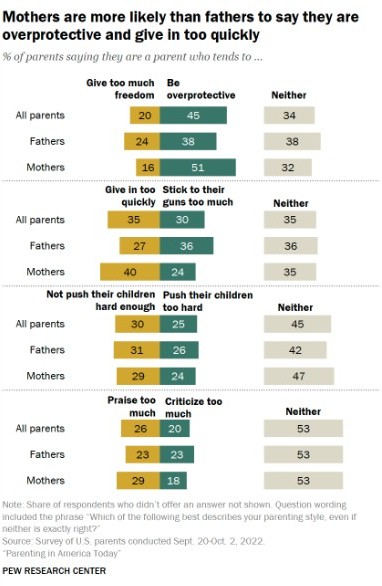
- Expectations of mothers and fathers as dictated by gender can lead people to treat parents differently.
Reflection Question: Why do you think people act differently when fathers and mothers do the same thing? What assumptions are you making when you see parents in different roles?
 Rethinking Gender and Parenting: Why Caregiving Isn’t Just Women’s Work